
I Added a Human Review Gate to My AI X Post Workflow
When I use AI to improve an X post, I do not let the best-sounding variant win automatically. My review gate takes a few minutes: verify the claim, choose the version that preserves the point, and decide whether the ending invites a useful reply. That keeps AI in the role it is good at—producing options—while I keep responsibility for what gets published.
That distinction matters because a post can become punchier while becoming less true, less specific, or less like the person behind it. Beastify is useful here: it analyzes a rough post, flags a primary weakness, and returns several rewrite strategies. Its own documentation calls the scores editorial heuristics, not predictions, which is exactly how I treat them.
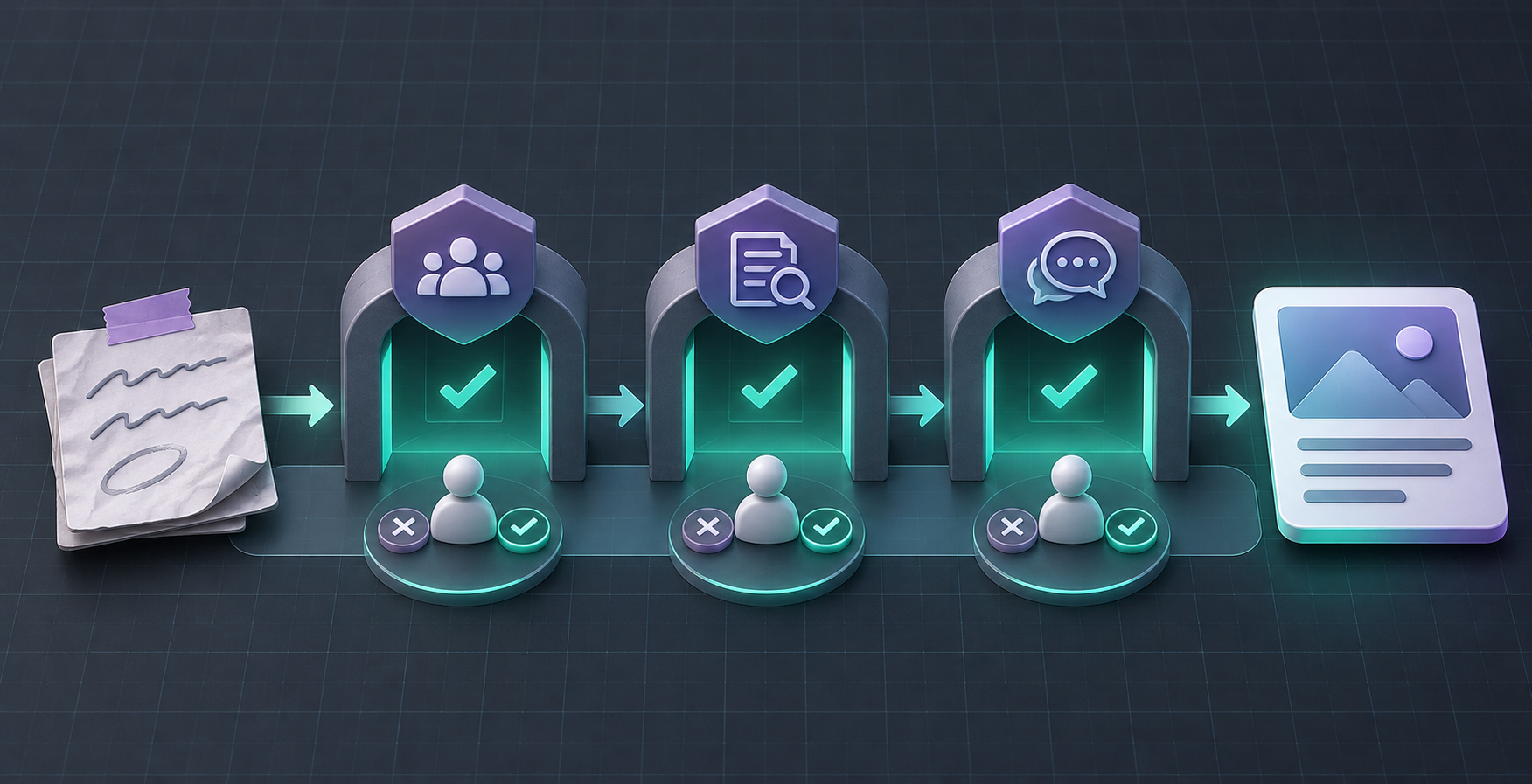
The small review gate I use
I put every candidate through three gates before copying it into X. The rule is simple: if a variant fails one gate, it is an input for another edit, not a publishable post.
| Gate | Question I ask | What makes me reject it |
|---|---|---|
| Claim | Can I support every concrete statement? | It introduces a result, customer outcome, or comparison I cannot prove. |
| Point | Is the reader able to say what this post is about after one read? | It has a sharper hook but hides the actual lesson. |
| Reply | Does the ending create a real opening for an informed response? | It asks for generic engagement or manufactures a fight. |
This is a lightweight version of the quality scorecard I use for automated publishing: the automation can assemble candidates, but a clear accept-or-revise decision still needs an owner. The same boundary made a difference in my Shopify blog automation review gate, where publishing on schedule was never enough reason to publish.
Start with one accountable draft
A review process cannot rescue a post that is trying to announce five things at once. Before I ask for rewrites, I write a plain source draft with three parts:
- The observed problem or decision.
- One verifiable detail that makes it concrete.
- The useful question or implication for the reader.
For example, I would rather start with: "We stopped treating every support request as a one-off and grouped the recurring setup issue before changing onboarding" than "We made onboarding way better." The first draft gives a rewriter something bounded to clarify. The second invites it to invent momentum.
This is the same reason I turn patterns into a defined working unit before automating them. In my Notion-to-Webflow schema-change test, the useful work begins with an explicit contract, not a vague request to "sync everything."
Use rewrite scores as prompts, not a grade
Beastify evaluates hook, clarity, specificity, curiosity, personality, and conversation, then supplies three or four variants with different strategies. I use those categories to locate the next edit; I do not average them into a pass/fail score. A highly curious opener that changes the meaning is worse than an ordinary opener that tells the truth.

Here is the short review loop I run:
- Paste the accountable draft and ask for options, not a final answer.
- Compare each option against the original sentence by sentence.
- Keep only the language that improves reader comprehension without adding an unsupported promise.
- Rewrite the last line myself if the suggested question feels like an engagement prompt rather than a genuine trade-off.
The tool can also transform a selected version toward a stronger hook, shorter form, a more human voice, humor, or a new angle. That is helpful only after I decide what must not change. For a practical precedent, Beastify’s API documentation describes the improve endpoint as returning an analysis plus 3–4 rewrites; it also documents a separate transform endpoint for a selected version.
My decision rule for accepting a variant
I accept a suggested opening only if it earns a "yes" to all three of these checks:
- Would I still stand behind it if the linked feature or result did not exist? If not, the post may be relying on hype rather than an insight.
- Did the rewrite preserve the operative constraint? Terms such as "before launch," "for one collection," or "after approval" often carry the whole truth of the lesson.
- Can a reader act on the post without needing the product? A product link can deepen the workflow, but the post should be useful on its own.
This is how I keep an AI rewrite from flattening a working decision into a slogan. It mirrors the approach behind my manual Notion-to-Webflow publishing cost check: quantify the trade-off, then decide which manual checkpoint is worth retaining.
Where automation stops
Automation can prepare a draft, produce alternatives, and hold a checklist. It should not independently approve factual claims, sensitive jokes, customer implications, or a meme that changes the tone of a product announcement. Beastify can suggest a meme when it fits, but I treat that as a creative option—not a reason to add one.

My stop conditions are equally useful for a solo founder and a small content team:
- Pause when a rewrite adds a number, benchmark, or outcome not present in the source draft.
- Pause when a shorter version drops the condition that makes the claim true.
- Pause when the humor needs private customer context to make sense.
- Publish only after one named person has read the final copy, link, and attached visual.
That last step is not bureaucracy. It is the same low-cost canary pattern I use before a broader change, such as my first-cut budget for a launch video: make a bounded decision early, while the cost of changing it is still small.
The workflow I would reuse
If you want faster social writing without turning it into an unattended publishing machine, start with one real observation. Ask an AI tool to show you alternatives. Then run the claim, point, and reply gate before posting.
Try the next draft in Beastify and keep the variant that makes the reader’s job clearer—not merely the one that sounds most dramatic. The human review gate is the part that protects your voice and your credibility.